Product passports, when the EU asks for them.
Textile passports are not required yet. Here is what is known, with the source for every date.
Sources checked October 2026. Not legal advice.
The timeline, with sources.
Every date on this page links to the EU text or the Commission page it comes from.
2022
ESPR is proposed, with a textiles strategy
30 March 2022
The Commission proposes the Ecodesign for Sustainable Products Regulation, known as ESPR, and publishes its strategy for textiles, which calls for a digital product passport for textiles.
EU textiles strategy, European CommissionESPR proposal, COM(2022) 142
2024
ESPR is published
28 June 2024
ESPR is published in the Official Journal as Regulation (EU) 2024/1781.
ESPR enters into force
18 July 2024
It sets the framework for passports. It does not say what a textile passport must hold.
2025
The first ESPR working plan
16 April 2025
Textiles and apparel are a priority group, with the textile rules expected in 2027. Being on the plan does not make a passport mandatory.
Working plan 2025 to 2030, COM(2025) 187Digital product passport FAQ, European Commission
2026
The EU passport registry opens
20 July 2026
Each passport will be registered there, while the product data itself stays with the company or its service provider.
Registry rules enter into force
6 August 2026
Implementing Regulation (EU) 2026/1778 sets how the registry works. Apparel has no registration duty until a textile delegated act is adopted.
2027
The first passport deadline in EU law
18 February 2027
It covers certain large batteries. Apparel is not among them.
The textile delegated act
2027, expected
The Commission is expected to adopt it. It will set what a textile passport must hold.
2028
Textile rules can apply
At the earliest
ESPR rules apply no earlier than 18 months after a delegated act enters into force, unless a shorter period is justified.
What a passport is, and what is still open.
A passport is a digital record linked to a product through a data carrier, such as a QR code, with an identifier registered in the EU registry.
The delegated act for each product group decides what its passport must hold. For textiles that act has not been adopted, so any list of textile fields published today is a draft. Every inspection on Pacod is timestamped on the style record, which is where a passport’s quality evidence would come from.
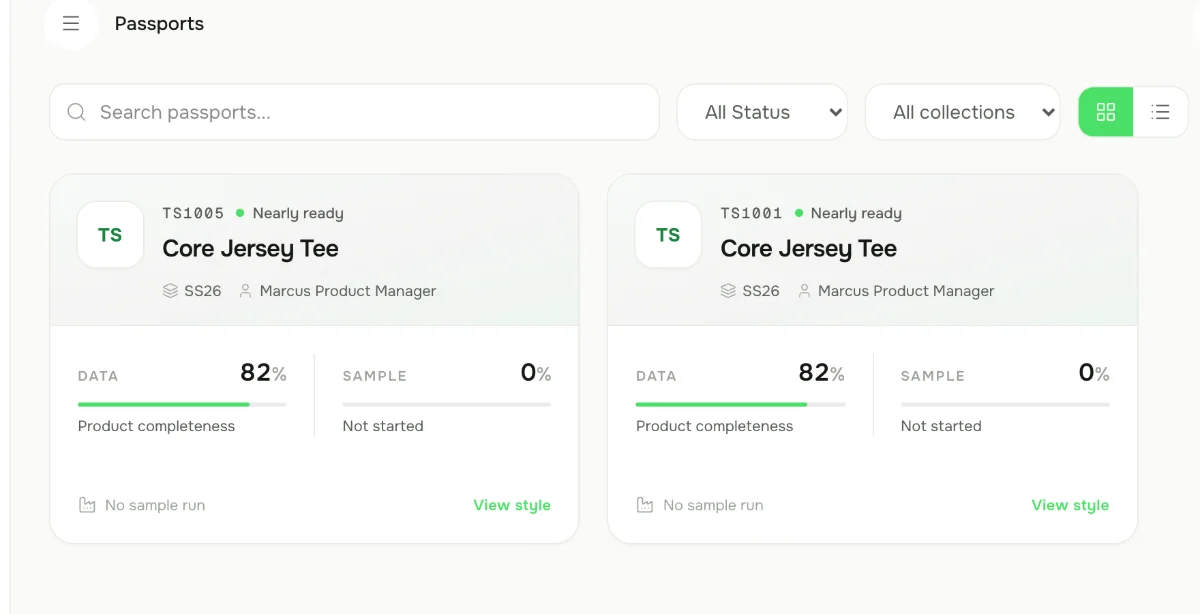
What Pacod does for your passports.
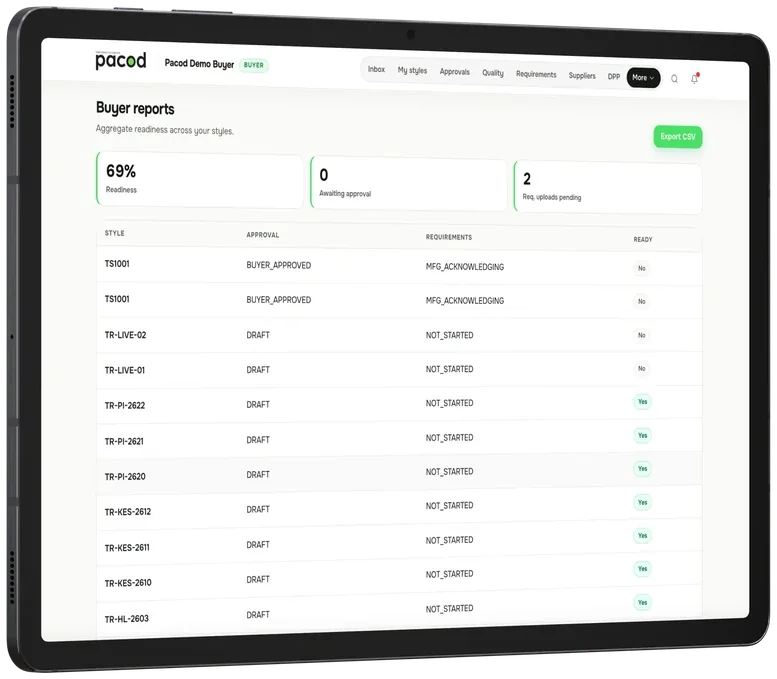
Publish a passport with a GS1 QR code
Built from the style record you already keep.
An EU readiness score
For each style, so you can see what is missing before anyone asks.
Inspection evidence on every style
Every inspection is timestamped on the style record the passport is built from.
Check your range against the timeline.
Book 20 minutes. We will go through what applies to your styles and markets.
- One style is enoughSend one style. We walk it through Pacod and show you what it produces.
- A person answersSomeone from the team that builds Pacod.
- Close to the floorFrom Sri Lanka and India, on UTC+5:30.